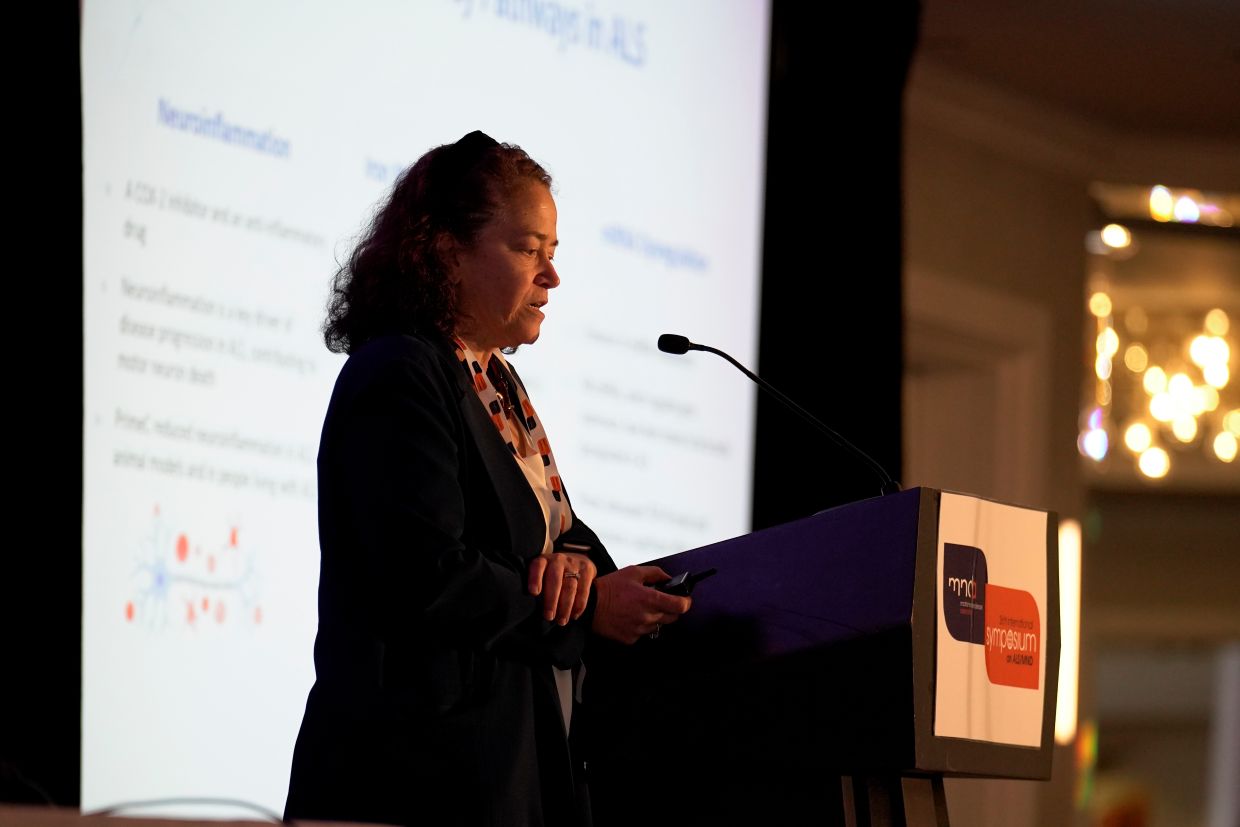
The clinical trials session is always the most anticipated and well attended session of the Symposium. This year was no different!
Professor Merit Cudkowicz shared updates on a drug called Prime C. Prime C is a combination of two existing medications; an antibiotic called Ciprofloxacin and a non-steroidal anti-inflammatory agent called Celecoxib. Research has suggested Prime C may reduce inflammation and iron build-up in the brain, both of which are thought to contribute to motor neurone damage. Prime C was found to be safe and well tolerated in a phase 2 clinical trial, and showed promising signs of slowing disease progression over 6 months.
Today, Professor Cudkowicz took a deeper dive into the results from the phase 2 trial and open-label extension. An open-label extension means everyone on the trial receives the drug after the initial trial. In the Prime C 12 month open label study, there was a 33% slowing in functional decline (as measured by the ALSFRS-R). Of particular note was an improvement in speech and swallowing. She also discussed how Prime C showed an effect on biological markers of MND after 18 months – it lowered levels of ferritin (a protein that stores iron in cells) and there was a small reduction in levels of a marker of neurone damage called Neurofilament Light chain.
These results mean Prime C is now moving to a larger phase 3 trial, PARAGON in the US, Europe and Israel. This will be a 48-week study involving around 300 people with MND and aims to investigate whether treatment with Prime C can slow functional decline, measured by the ALSFRS-R.
Read more Prime C.
