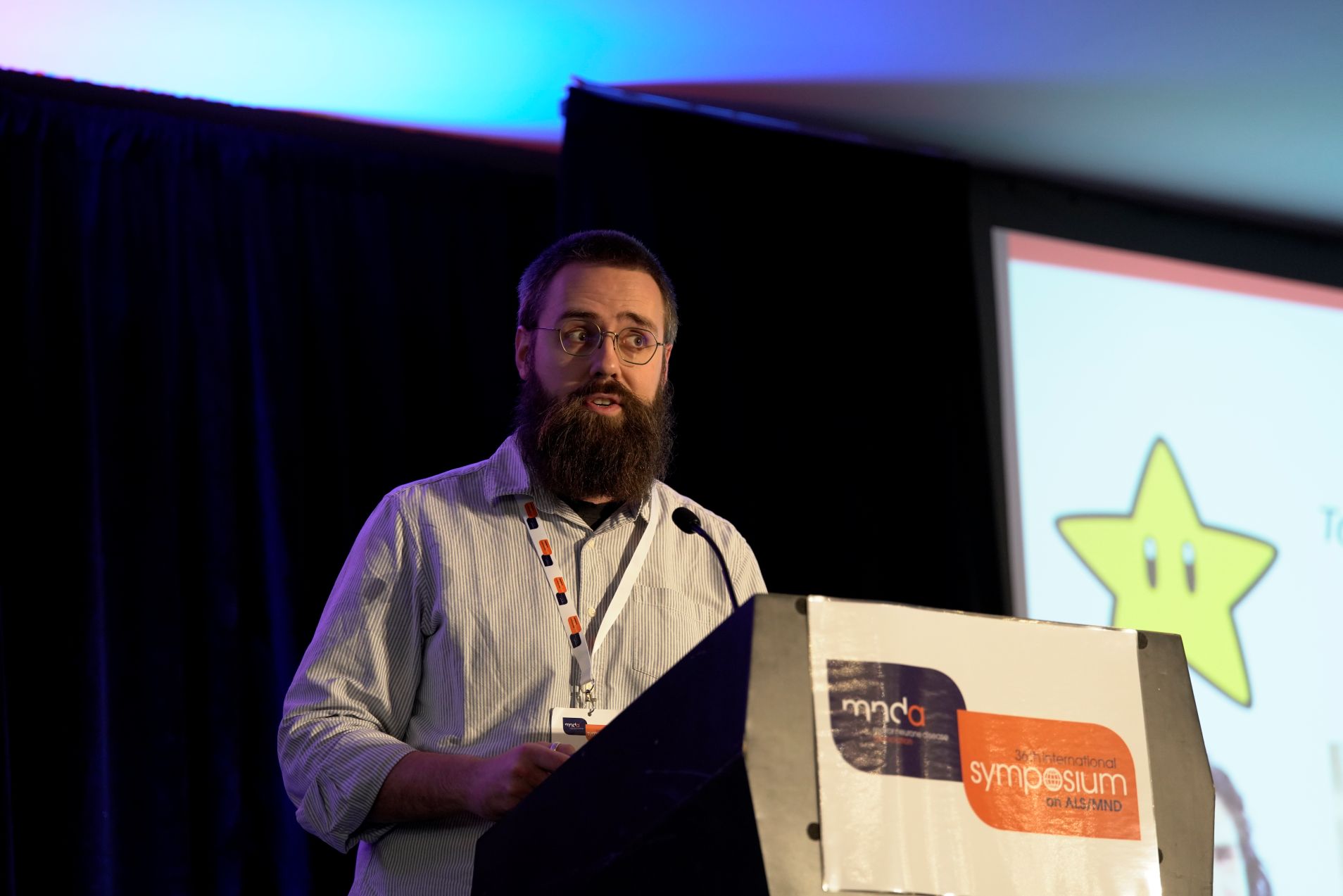
We’ve just heard some really interesting talks in the Cognitive and Psychological Assessment and Support session.
Professor Sharon Abrahams opened, and explained that around half of people with MND experience changes in thinking and behaviour. Prof Abrahams highlighted the importance of testing for thinking and behaviour changes in MND, and described the Edinburgh Cognitive and Behavioural ALS screen (ECAS), a test used to identify different types of thinking and behaviour symptoms in MND. She also shared that ECAS scores may be able to predict the build-up of TDP-43 (a protein which forms abnormal clumps in the brains of people with MND) in certain areas of the brain which are linked to thinking and behaviour. Prof Abrahams ended her talk by discussing strategies to support people with MND in making decisions about their care.
Dr Ratko Radakovic also shared his work on whether thinking and behaviour changes in MND can predict how long a person lives after diagnosis. In Dr Radakovic’s study, people with MND who had completed the ECAS were sorted into groups based on their thinking and behaviour. Using statistical tests, Dr Radakovic and his team found behavioural symptoms might be linked to longevity, and could potentially be used as a predictor of survival. Changes in food preferences and repetitive actions were linked to people living for less time. This has implications for future testing and care for people with MND. It also highlights the importance of testing for changes in thinking and behaviour, and could lead to better predictions of how long someone with MND will live.
This has implications for future testing and care for people with MND. It also highlights the importance of testing for changes in thinking and behaviour, and could lead to better predictions of how long someone with MND will live.
