Hi! My name is Katie and I have recently joined the MND Association’s Research team as a Research Insight Co-ordinator. I’ll be working to stay updated with the latest advances in MND research and helping to share that information with the MND community through blog posts and website news.
I have recently graduated from the University of Bristol where I completed my postgraduate degree in Molecular Neuroscience. I also have a background in genetics, having completed my bachelor’s degree in Medical Genetics from the University of Leicester.
During my MSc, my research project investigated how a tool called focused ultrasound stimulation (FUS) can be used to change the activity of different areas of the brain. FUS is similar to the ultrasound used in medical imaging, but where this ultrasound looks at a broad area, FUS is more precise and can target cells deep within the brain. FUS works by changing the activity of neurones. The sound waves released by the FUS machine exert tiny pressure on the cells, which triggers firing of the neurones. Different settings on the ultrasound machine can also be used to control whether activity in the neurones is increased or decreased.
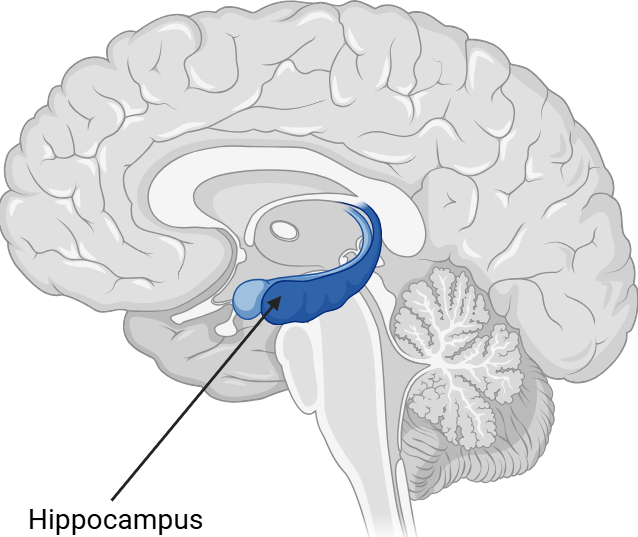
I used the hippocampus of rats in my experiments. The hippocampus is the area of the brain responsible for learning and memory. It has known subregions which have been well studied and experimented on. This made it an ideal model for understanding whether FUS could target one area without affecting areas nearby. This is important to know to understand how precise FUS can be. In neurological diseases, not all areas of the brain are affected. While treating one damaged area we don’t want to cause toxic side effects in healthy tissue nearby.
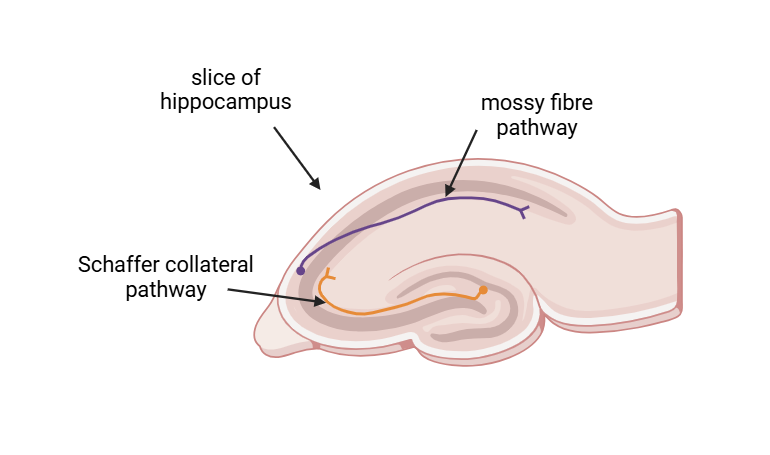
Within my research I looked at two connected chains of nerve fibres (known as neural pathways) in the hippocampus that allow the transfer of signals from one area to another. I looked at the mossy fibre pathway and the Schaffer collateral pathway. The mossy fibre pathway is responsible for forming new memories, while the Schaffer collateral pathway is important for storing memories and memory retrieval.
In my project I found there was no significant change in neurone activity when compared to a control which had not undergone FUS. This was the case for both pathways. However, this is still important to know. It is possible this result was because the settings on the ultrasound machine were not the right ones to cause a measurable increase/ decrease in activity. This helps inform what the right settings are to cause the desired effect. More research is required to identify what the optimal settings are.
Additional research is also needed to better understand the full potential of FUS. This could involve treatment of psychological and neurological disorders in the future. Research is currently being carried out to understand the effects it has in treating these different conditions, for example in treating Alzheimer’s disease or epilepsy. Alongside this, more recent research has begun to explore the possibility of using FUS for treating MND. A clinical trial taking place in Spain is using a specific type of FUS to target the motor cortex in people with MND. In MND, it has been shown that the motor cortex can become over-excited leading to nerve damage. The aim of this trial is to reduce the activity of the motor cortex. This study is expected to finish later this year, so it will be interesting to see the outcome of it. You can find out more about this trial here.
My interest in MND developed during my MSc, when I chose to learn more about it for a coursework project. MND was not covered in our teaching, so I took the opportunity to explore it in more detail. I was aware of MND through my mum’s job as an Occupational Therapist. I heard about her work with people living with MND, and the impact it had on people and their families. This inspired me to learn more about MND during my studies, and as a result, I became very interested in it.
When I am not at work, I enjoy reading (particularly when surrounded by the sea and some sun), walking my dogs and spending time with my friends. I am most looking forward to learning more about the research happening within the field of MND and to contribute to work that makes a difference for people within the MND community.
