From gene discovery to potential treatments, the story of FUS-MND is a remarkable example of how scientific research and collaboration can lead to a potential targeted therapy (a drug that will potentially halt the progression of MND in people with a specific genetic form of the disease).
Last Friday, at the 7th ALS/MND International Symposium hosted by the UCL Queen Square MND Centre in London, internationally recognised speakers shared hot topics in MND research and healthcare. Among the many exciting developments discussed was a fascinating talk from Dr Neil Shneider, who recapped the story of FUS, a gene linked to a form of MND, and the new therapeutic developments that stem from this research.
FUS-MND is the term used to describe a specific type of MND where someone has a change in the FUS gene. This type affects around 1% of people with MND and is a rare genetic form of the disease. Dr Shneider’s presentation touched on the development of an experimental treatment for FUS-MND that is currently being tested in a clinical trial called FUSION. With early results from the trial expected this year, now is a good time to look back at the story so far, from the discovery of FUS-MND to the research that has led to a potential treatment.
What is FUS?
FUS stands for ‘Fused in Sarcoma’. It is a protein that plays an important role in many cells throughout the body. It helps cells read genetic instructions correctly and supports the repair of damaged DNA – the biological instruction manual inside your body’s cells that tells them how to build, run, and repair your entire body. This protein also contributes to the development and strength of the connections between nerve cells and muscles.
How is FUS linked to MND?
The FUS gene was initially linked to MND in 2009 by several lab groups. Professor of Neurology and Neurogenetics Chris Shaw and his group at King’s College London worked in collaboration with Dr Robert Brown, a Professor of Neurology, and his team in Massachusetts General Hospital in the United States to test MND families for changes in the FUS gene. Senior lecturer in neuroscience at King’s College London, Dr Caroline Vance, who worked in Chris Shaw’s lab and whose work was partly funded by the MND Association, was one of the first to identify FUS gene changes in families with MND, suggesting these genetic changes can be inherited. This finding was reinforced by independent studies from Dr Brown’s lab using US families, and later in an Italian group looking at European families with MND. These studies, all published in 2009, began the surge of research into FUS-linked MND.
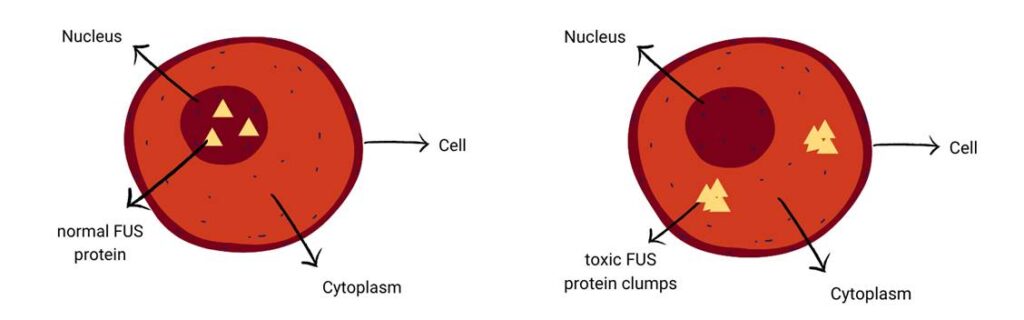
Further research into FUS and MND found that a change in the FUS gene causes a change in the FUS protein. The FUS protein normally stays in the cell’s control centre (the nucleus) to carry out essential roles in cell maintenance and repair. In people with a change in the FUS protein, this protein was found to leave the nucleus of the cell, resulting in the protein no longer able to function normally. Researchers in the US and Europe found that when the faulty FUS protein leaves the cell nucleus, the FUS proteins can stick together and form toxic clumps located inside the cell body but not within the nucleus where they should be. Over time these clumps can damage the cell and contribute to motor neurone death. Read more about the genetic forms of MND in our back-to-basics blog.
Results from one key study published in 2010 by Professor Ian Blair and Professor Garth Nicholson in Sydney who reported that the different types of gene changes within the FUS gene can lead to different levels of disease severity. Most importantly, the study showed FUS-linked MND was a clear genetic subtype of MND.
More than 50 different changes in the FUS gene have been found within people with FUS-MND, but the effects of each change can vary. Some changes may cause the disease to be more aggressive and faster progressing than others. Some FUS gene changes can be particularly aggressive compared to the other types of the disease and this variation is the most common genetic cause of childhood-onset MND.
FUS-MND can affect people of all ages, from childhood to adulthood and often progresses rapidly. Although early studies showed FUS gene changes can be inherited through families, in some cases it is possible to develop a change in the FUS gene without a family history.
Through this early research, the damaging effects of changes in the FUS gene were discovered. Specifically, the discovery that a buildup of toxic FUS proteins outside of the cell’s nucleus contributed to cell death. Once researchers understood more about what was going wrong in FUS-MND, the focus began to shift from understanding the disease to finding ways to treat it. Researchers uncovered several targets for potential treatments; they could look to remove the protein clumps or prevent them from forming in the first place.
Ulefnersen: The start of a new treatment
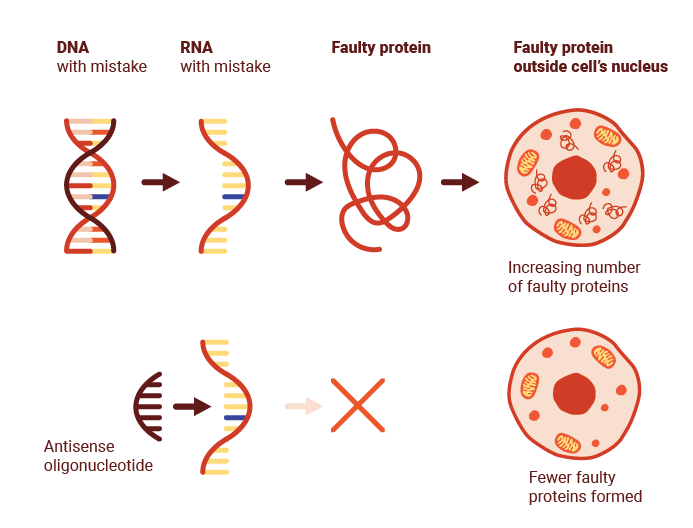
An experimental drug treatment called ulefnersen was developed by Ionis Pharmaceuticals to target the changes in the FUS gene and reduce its damage to the cell. Ulefnersen is an antisense oligonucleotide (ASO) drug treatment designed to reduce the production of faulty FUS protein in cells, aiming to lower the harmful effects. An ASO is a tiny, man-made piece of genetic material designed to stick to a specific message inside your cells and block it from making a harmful protein, in this case FUS. The drug is given through a lumbar puncture, an injection into the fluid surrounding the brain and spinal cord, helping the drug reach affected motor neurones.
An ASO therapy is already being used to treat another type of MND, called SOD1-MND. This ASO called tofersen has now been approved as a treatment for SOD1-MND in 44 countries, including the UK which is currently available privately and under review to decide if it will be provided on the NHS. Additional clinical trials of ASOs are also underway for other genetic forms of MND.
The first person with FUS-MND to be given ulefnersen was Jaci Hermstad in the USA. Dr Neil Shneider, a clinician working with people with MND, became involved in Jaci’s care after her diagnosis with FUS-MND in 2018. Jaci’s identical twin, Alex, had died from FUS-MND years before Jaci’s diagnosis. At that time, there were no treatments available for FUS-MND.
Dr Shneider and Dr Brown reached out to contacts within Ionis Pharmaceuticals about accessing a potential treatment under development for FUS-MND. Ionis agreed to provide ulefnersen to treat Jaci while it was still in testing. As this treatment was experimental and unlicensed, Dr Shneider needed to seek approval from regulatory authorities in the USA through a named patient basis programme. This is a specialist programme that allows people with life-threatening conditions to access an experimental treatment when there are no approved options available. Permission to give a treatment through this programme must be granted by regulatory authorities in that country.
While the approval process was underway, researchers continued to test the drug in mice and human cells in a laboratory. The treatment was shown to reduce levels of FUS protein in the brain and spinal cord. It also helped to protect nerve cells from the harmful effects of the toxic FUS proteins. These findings demonstrated the drug worked in laboratory models designed to mimic FUS-MND.
The US Food and Drug Administration (FDA) approved the use of ulefnersen for Jaci in 2019, making her the first person to receive this treatment. Jaci bravely began treatment at a late stage of her disease but died a year later. However, tests of her brain tissue showed FUS protein levels had been dramatically reduced since taking the treatment. This suggested the treatment was reaching its target but, unfortunately, Jaci was only able to access the treatment late in the course of her illness, which suggests she may already have lost too many motor neurones for the treatment to significantly affect the course of her disease.
While Jaci has since passed, her spirit and courage have inspired us all.
– Ionis FUS-ALS Team.
A turning point
Following early findings from the experience with Jaci, ulefnersen was provided through an expanded access programme, a programme that offers people with life-threatening illnesses access to a treatment before it has been approved by regulatory bodies. The drug was given to a further 12 people with FUS-MND in the USA from 2019 to 2023 through this programme. The study measured physical functions using the ALS Functional Rating Scale-Revised (ALSFRS-R). Researchers also measured neurofilament levels, a marker of nerve cell damage, and examined FUS protein levels in biological samples.
Neurofilament levels in people on the treatment fell by up to 82.8% after six months. This suggested damage to the nerve cells may have been reduced. However, this reduction in neurofilament levels did not translate into clear improvements in everyday function for most people in the study and many still died from the disease. Researchers suggested the fast progression of the disease may make the treatment timing crucial. Those who started the treatment late in the course of their disease may already have experienced a significant loss of motor neurones, which could have limited the ability of the drug to improve physical symptoms.
One of the participants, Anna, who had a particularly aggressive change in the FUS gene, started treatment relatively early in her disease compared to other participants. After 10 months, she showed an unexpected improvement in function and survived for over five years from the initial treatment. Her amazing story was highlighted back at the 2023 International Symposium on ALS/MND which can be watched below.
Another participant carrying a FUS gene change received the treatment before developing any symptoms of MND. Throughout the trial they remained symptom-free and showed improved nerve function. Studies of brain tissue from those who died also clarified the previous findings showing lower levels of FUS protein and fewer signs of FUS-related damage.
Overall, ulefnersen was found to be safe and showed some promising signs of improving survival in some people. Researchers suggested improvements in symptoms might take time to appear and that earlier treatments could lead to better outcomes.
While these results looked promising, the drug needed a larger clinical trial to find out if the drug could be an effective treatment.
Taking ulefnersen into a large clinical trial
Following results from the previous case studies, Ionis Pharmaceuticals set up a larger clinical trial to test the drug ulefnersen in a larger cohort of people. This trial was called FUSION. The trial formally began in 2021 with the aim of further developing our understanding of the drug’s safety and its effects on people with FUS-MND. Initial results from this trial are expected this year. Ulefnersen is not currently available anywhere in the world outside of the clinical trial. You can find out more about this trial on our website.
Precision medicines, such as ulefnersen, are treatments that are designed to target specific genetic, biological or disease characteristics for a small group of people. These treatments represent a new and more targeted era in MND research. Treatments such as tofersen (for SOD1-MND) have shown it is possible to develop therapies aimed at specific genetic forms of MND. Even when early studies do not give all the answers, they help researchers learn more about the disease and how best to design future trials. Researchers at Columbia University are now looking to develop more precision medicines for other MND-linked genes through a new programme called Silence-ALS.
This progress is only possible because of the bravery and commitment of people with MND and their families who take part in research. Their contribution keeps people affected by MND at the centre of the search for effective treatments.
